Welcome Dear Student and Shine in NEET with Shine NEET SmartPrep!.
All NEET - 2014 questions are displayed here. But you would be able to try only a sub set of these questions in your free trial. We recommend you explore the full system and go for a one time subscription if you are satisfied.
Try it out and feel the difference!!
Subscribe to full version of smart test prep solution for the same cost of a
static and boring printed question bank!
Limited-Time Offer: Get all this for just ₹1199
Why settle for outdated methods when you can prepare smarter, track better, and score higher?
Subscribe Now & Take Control of Your NEET Prep !
1. If force (F), velocity (V) and time (T) are taken as fundamental units, then the dimensions of mass are
(1). [F V T−1]
(2). [F V T −2]
(3). [F V−1 T −1]
(4). [F V−1 T ]
2. A projectile is fired from the surface of the earth with a velocity of 5 m\(s^{−1}\) and angle θ with horizontal. Another projectile fired from another planet with a velocity of 3 m\(s^{−1}\) at the same angle follows a trajectory which is identical with the trajectory of the projectile fired from the earth. The value of the acceleration due to gravity on the planet is (in m\(s^{−2}\)) is (Given: g = 9.8m\(s^{−2}\))
(1). 3.5
(2). 5.9
(3). 16.3
(4). 110.8
3. A particle is moving such that its position coordinates (x, y) are (2 m, 3 m) at time t = 0, (6 m, 7 m) at time t = 2 s and (13 m, 14 m) at time t = 5 s. Average velocity vector \(\vec{v}_{av}\) from t = 0 to t = 5 s is
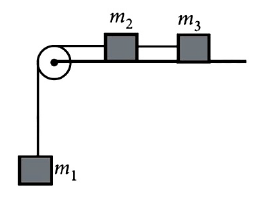
4. A system consists of three masses \(m_1\), \(m_2\) and \(m_3\) connected by a string passing over a pulley P. The mass \(m_1\) hangs freely and \(m_2\) and \(m_3\) are on a rough horizontal table (the coefficient of friction = \(\mu\)).The pulley is frictionless and of negligible mass. The downward acceleration of mass \(m_1\) is (Assume \(m_1\) = \(m_2\) = \(m_3 \) = m)
(1). \(\frac{g\left(1 − g\mu\right)}{9}\)
(2). \(\frac{2g\mu}{3}\)
(3). \(\frac{g\left(1 − 2\mu\right)}{3}\)
(4). \(\frac{g\left(1 − 2\mu\right)}{2}\)
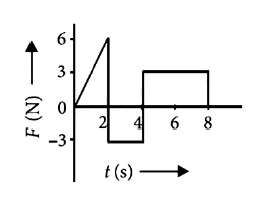
5. The force F acting on a particle of mass m is indicated by the force-time graph shown below. The change in momentum of the particle over the time interval from zero to 8 s is
(1). 24 N s
(2). 20 N s
(3). 12 N s
(4). 6 N s
6. A balloon with mass m is descending down with an acceleration a (where a < g). How much mass should be removed from it so that it starts moving up with an acceleration a?
(1). \(\frac{2ma}{g + a}\)
(2). \(\frac{2ma}{g − a}\)
(3). \(\frac{ma}{g + a}\)
(4). \(\frac{ma}{g} − a\)
7. A body of mass (4m) is lying in x-y plane at rest. It suddenly explodesinto three pieces. Two pieces, each of mass (m) move perpendicular toeach other with equal speeds (v). The total kinetic energy generated dueto explosion is
(1). mv2
(2). 32mv2
(3). 2mv2
(4). 4mv2
8. A solid cylinder of mass 50 kg and radius 0.5 m is free to rotate aboutthe horizontal axis. A mass less string is wound round the cylinder with one end attached to it and other hanging freely. Tension in the string required to produce an angular acceleration of 2 revolutions s−2 is
(1). 25 N
(2). 50 N
(3). 78.5 N
(4). 157 N
9. The ratio of the accelerations for a solid sphere (mass m and radius R) rolling down an incline of angle θ without slipping and slipping down the incline without rolling is
(1). 5 : 7
(2). 2 : 3
(3). 2 : 5
(4). 7 : 5
10. Copper of fixed volume \(V\) is drawn into wire of length \(l\). When this wire is subjected to a constant force \(F\), the extension produced in the wire is \(\Delta l\). Which of the following graphs is a straight line?
(1). \(\Delta l\) versus \(1/l\)
(2). \(\Delta l\) versus \(l^2\)
(3). \(\Delta l\) versus \(\frac{1}{l^2}\)
(4). \(\Delta l\) versus \(l\)
11. A certain number of spherical drops of a liquid of radius \(r\) coalesce to form a single drop of radius \(R\) and volume \(V\) If \(T\) is the surface tension of the liquid, then
(1). energy = \(4V T \left(\frac{1}{r} - \frac{1}{R}\right)\) is released
(2). energy = \(3V T \left(\frac{1}{r} + \frac{1}{R}\right)\) is absorbed
(3). energy = \(3V T \left(\frac{1}{r} - \frac{1}{R}\right)\) is released
(4). energy is neither released nor absorbed
12. Steam at \(100^\circ C\) is passed into \(20 g\) of water at \(10^\circ C\). When water acquires a temperature of \(80^\circ C\), the mass of water present will be [Take specific heat of water = \(1cal g^{−1 \circ} C^{−1}\) and latent heat of steam = \(540 cal g^{−1}\)]
(1). \(24 g \)
(2). \(31.5 g \)
(3). \(42.5 g \)
(4). \(22.5 g \)
13. Certain quantity of water cools from \(70^\circ C\) to \(60^\circ C\) in the first \(5\) minutes and to \(54^\circ C\) in the next \(5\) minutes. The temperature of the surroundings is
(1). \(45^\circ C\)
(2). \(20^\circ C\)
(3). \(42^\circ C\)
(4). \(10^\circ C\)
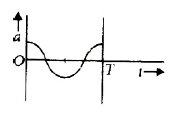
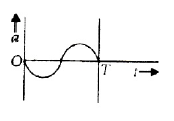
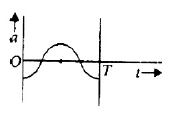
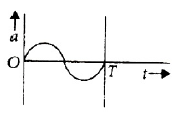
14. The oscillation of a body on a smooth horizontal surface is represented by the equation, \(X = A cos(ωt)\) Where \(X\) = displacement at time \(t\), \(ω\) = frequency of oscillation. Which one of the following graphs shows correctly the variation a with \(t\) ? Here \(a\) = acceleration at time \(T\) = time period
(1).
(2).
(3).
(4).
15. The number of possible natural oscillations of air column in a pipe closed at one end of length \(85\,cm\) whose frequencies lie below \(1250\, Hz\) are (Velocity of sound = \(340\,ms^{−1}\))
(1). \(4\)
(2). \(5\)
(3). \(7\)
(4). \(6\)
16. A speeding motorcyclist sees traffic jam ahead of him. He slows down to \(36\, kmhour^{−1}\). He finds that traffic has eased and a car moving ahead of him at \(18\, kmhour^{−1}\) is honking at a frequency of \(1392\, Hz\). If the speed of sound is \(343\, ms^{−1}\), the frequency of the honk as heard by him will be
(1). \(1332\, Hz\)
(2). \(1372\, Hz\)
(3). \(1412\, Hz\)
(4). \(1454\, Hz\)
17. In an ammeter 0.2% of main current passes through the galvanometer.If resistance of galvanometer is G, the resistance of ammeter will be
(1). \(\displaystyle\frac{1}{499}\)G
(2). \(\displaystyle\frac{499}{500}\)G
(3). \(\displaystyle\frac{1}{500}\)G
(4). \(\displaystyle\frac{500}{499}\)G
18. Two identical long conducting wires AOB and COD are placed at right angle to each other, with one above other such that O is their common point for the two. The wires carry I1 and I2 currents, respectively. Point P is lying at distance d from O along a direction perpendicular to the plane containing the wires. The magnetic field at the point P will be
19. A black hole is an object whose gravitational field is so strong that even light cannot escape from it. To what approximate radius would earth (mass = \(5.98 × 10^{24}kg\)) have to be compressed to be a black hole?
(1). \(10^{−9} m\)
(2). \(10^{−6} m\)
(3). \(10^{−2} m\)
(4). \(100 m\)
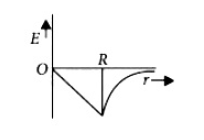
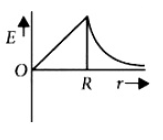
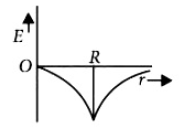
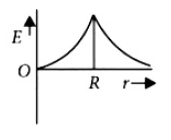
20. Dependence of intensity of gravitational field (E) of earth with distance(r) from centre of earth is correctly represented by
(1).
(2).
(3).
(4).
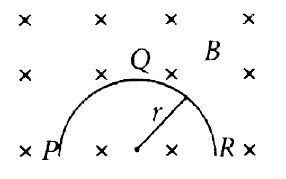
21. A thin semicircular conducting ring (PQR) of radius r is falling with its plane vertical in a horizontal magnetic field B, as shown in the figure.The potential difference developed across the ring when its speed is v, is
(1). zero
(2). \(\frac{Bv\pi r^2}{2}\) and P is at higher potential
(3). \(\pi rBv\) and R is at higher potential
(4). \(2rBv\) and R is at higher potential
22. A transformer having efficiency of 90% is working on 200 V and 3 kW power supply. If the current in the secondary coil is 6 A, the voltage across the secondary coil and the current in the primary coil respectively are
(1). 300 V, 15 A
(2). 450 V,15 A
(3). 450 V, 13.5 A
(4). 600 V, 15 A
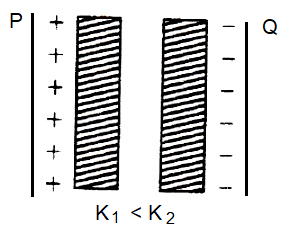
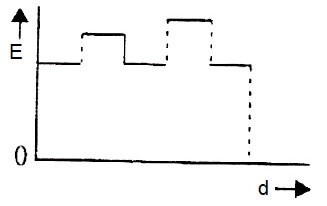
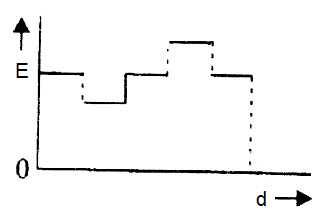
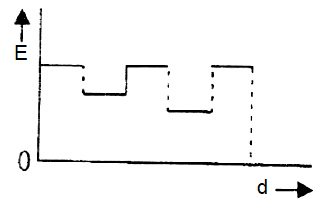
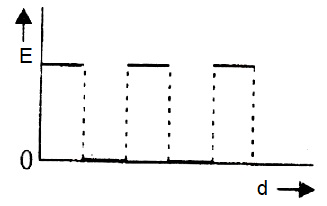
23. Two thin dielectric slabs of dielectric constants K1 and K2 (K1 < K2) arevinserted between plates of a parallel plate capacitor, as shown in the figure. The variation of electric field E between the plates with distanced as measured from plate P is correctly shown by
(1).
(2).
(3).
(4).
24. A thermodynamic system undergoes cyclic process ABCDA as shown in figure. The work done by the system in the cycle is
(1). p0V0
(2). 2p0V0
(3). p0V0/2
(4). zero
25. If n1, n2, and n3 are the fundamental frequencies of three segments into which a string is divided, then the original fundamental frequency n of the string is given by
26. A beam of light of \(\lambda\) = 600 nm from a distant source falls on a single slit 1 mm wide and the resulting diffraction pattern is observed on a screen 2 m away. The distance between first dark frings on either side of the central bright fringe is
(1). 1.2 cm
(2). 1.2 mm
(3). 2.4 cm
(4). 2.4 mm
27. In the Young's double-slit experiment, the intensity of light at a point on the screen (where the path difference is \(\lambda\) is K, (\(\lambda being the wavelength of light used). The intensity at a point where the path difference is \(\frac{\lambda}{4}\), will be
(1). K
(2). K/4
(3). K/2
(4). zero
28. If the focal length of objective lens is increased, then magnifying power of
(1). microscope will increase but that of telescope decrease
(2). microscope and telescope both will increase
(3). microscope and telescope both will decrease
(4). microscope will decrease but that of telescope increase
29. The angle of a prism is A. One of its refracting surfaces is silvered. Light rays falling at an angle of incidence 2A on the first surface returns back through the same path after suffering reflection at the silvered surface. The refractive index \(\mu\), of the prism is
(1). 2 sin A
(2). 2 cos A
(3). 1/2 cos A
(4). tan A
30. Hydrogen atom in ground state is excited by a monochromatic radiation of \(\lambda = 975 \mathring{A} \). Number of spectral lines in the resulting spectrum emitted will be
(1). 3
(2). 2
(3). 6
(4). 10
31. The binding energy per nucleon of \(_3Li^7\) and \(_2He^4\) nuclei are 5.60 MeV and 7.06 MeV, respectively. In the nuclear reaction \(_3Li^7 + _1H^1 \rightarrow _2He^2 + _2He^4 + Q\), the value of energy Q released is
(1). 19.6MeV
(2). -2.4 MeV
(3). 8.4 MeV
(4). 17.3 MeV
32. A radio isotope X with a half life 1.4 x 10sup9 yr decays of Y which is stable. A sample of the rock from a cave was found to contain X and Y in teh ratio 1:7. The age of the rock is
(1). 1.96 x 10⁹ yr
(2). 3.92 x 10⁹ yr
(3). 4.20 x 10⁹ yr
(4). 8.40 x 10⁹ yr
33. A monoatomic gas ata pressure p, having a volume V expands isothermally to a volume 2 V and then adiabatically to a volume 16 V. The final pressure of the gas is (take \(\gamma = \frac{5}{3}\))
(1). 64p
(2). 32p
(3). p/64
(4). 16p
34. The mean free path of molecules of a gas,, (radius r) is inversly proportional to [2014]