Your Performance Summary!
Questions Available: 10
Questions Attempted: 0
Number of Attempts: 0
Correct Attempts: 0
Total Time Spent: 00:00
Avg Time Per Question: 00:00
Year: 2024
Topic: Sexual Reproduction in Flowering Plants
1. Identify the type of flowers based on the position of calyx, corolla, and androecium with respect to the ovary from the given figures (a) and (b).
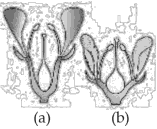
(1).(a) Perigynous; (b) Epigynous
(2). (a) Perigynous; (b) Perigynous
(3). (a) Epigynous; (b) Hypogynous
(4). (a) Hypogynous; (b) Epigynous
Solution
Year: 2024
Topic: Sexual Reproduction in Flowering Plants
2. Identify the set of correct statements:
A. The flowers of Vallisneria are colourful and produce nectar
B. The flowers of waterlily are not pollinated by water
C. In most of water-pollinated species, the pollen grains are protected from wetting
D. Pollen grains of some hydrophytes are long and ribbon like
E. In some hydrophytes, the pollen grains are carried passively inside water
Choose the correct answer fron the options given below:
A. The flowers of Vallisneria are colourful and produce nectar
B. The flowers of waterlily are not pollinated by water
C. In most of water-pollinated species, the pollen grains are protected from wetting
D. Pollen grains of some hydrophytes are long and ribbon like
E. In some hydrophytes, the pollen grains are carried passively inside water
Choose the correct answer fron the options given below:
(1).A, C, D, and E only
(2). B, C, D, and E only
(3). C, D, and E only
(4). A, B, C, and D only
Solution
Year: 2024
Topic: Sexual Reproduction in Flowering Plants
3. Identify the correct description about the given figure:
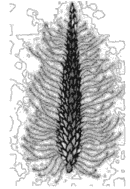
(1).Cleistogamous flowers showing autogamy.
(2). Compact inflorescence showing complete autogamy.
(3). Wind pollinated plant inflorescence showing flowers with well exposed stamens.
(4). Water pollinated flowers showing stamens with mucilaginous covering.
Solution
Year: 2025
Topic: Sexual Reproduction in Flowering Plants
4. How many meiotic and mitotic divisions need to occur for the development of a mature female gametophyte from the megaspore mother cell in an angiosperm plant?
(1).No Meiosis and 2 Mitosis
(2). 2 Meiosis and 3 Mitosis
(3). 1 Meiosis and 2 Mitosis
(4). 1 Meiosis and 3 Mitosis
Solution
Year: 2025
Topic: Sexual Reproduction in Flowering Plants
5. Given below are two statements : One is labelled as Assertion (A) and the other is labelled as Reason (R).
Assertion (A) : Cells of the tapetum possess dense cytoplasm and generally have more than one nucleus.
Reason (R) : Presence of more than one nucleus in the tapetum increases the efficiency of nourishing the developing microspore mother cells.
In light of the above statements, choose the most appropriate answer from the options given below:
Assertion (A) : Cells of the tapetum possess dense cytoplasm and generally have more than one nucleus.
Reason (R) : Presence of more than one nucleus in the tapetum increases the efficiency of nourishing the developing microspore mother cells.
In light of the above statements, choose the most appropriate answer from the options given below:
(1).A is false but R is true
(2). Both A and R are true and R is the correct explanation of A
(3). Both A and R are true but R is NOT the correct explanation of A
(4). A is true but R is false
Solution
Year: 2025
Topic: Sexual Reproduction in Flowering Plants
6. Given below are two statements :
Statement I : Fig fruit is a non-vegetarian fruit as it has enclosed fig wasps in it.
Statement II : Fig wasp and fig tree exhibit mutual relationship as fig wasp completes its life cycle in fig fruit and fig fruit gets pollinated by fig wasp.
In the light of the above statements, choose the most appropriate answer from the options given below :
Statement I : Fig fruit is a non-vegetarian fruit as it has enclosed fig wasps in it.
Statement II : Fig wasp and fig tree exhibit mutual relationship as fig wasp completes its life cycle in fig fruit and fig fruit gets pollinated by fig wasp.
In the light of the above statements, choose the most appropriate answer from the options given below :
(1).Statement I is incorrect but statement Il is correct
(2). Both statement I and statement II are correct
(3). Both statement I and statement Il are incorrect
(4). Statement I is correct but statement Il is incorrect
Solution
Solution
Year: 2025
Topic: Sexual Reproduction in Flowering Plants
8. Given below are two statements : One is labelled as Assertion (A) and the other is labelled as Reason (R).
Assertion (A) : A typical unfertilised, angiosperm embryo sac at maturity is 8 nucleate and 7-celled.
Reason (R) : The egg apparatus has 2 polar nuclei.
In the light of the above statements, choose the correct answer from the options given below :
Assertion (A) : A typical unfertilised, angiosperm embryo sac at maturity is 8 nucleate and 7-celled.
Reason (R) : The egg apparatus has 2 polar nuclei.
In the light of the above statements, choose the correct answer from the options given below :
(1).A is false but R is true
(2). Both A and R are true and R is the correct explanation of A
(3). Both A and R are true but R is NOT the correct explanation of A
(4). A is true but R is false
Solution
Year: 2025
Topic: Sexual Reproduction in Flowering Plants
9. Given below are two statements : One is labelled as Assertion (A) and the other is labelled as Reason (R).
Assertion (A) : Both wind and water pollinated flowers are not very colourful and do not produce nectar.
Reason (R) : The flowers produce enormous amount of pollen grains in wind and water pollinated flowers.
In the light of the above statements, choose the correct answer from the options given below :
Assertion (A) : Both wind and water pollinated flowers are not very colourful and do not produce nectar.
Reason (R) : The flowers produce enormous amount of pollen grains in wind and water pollinated flowers.
In the light of the above statements, choose the correct answer from the options given below :
(1).A is false but R is true
(2). Both A and R are true and R is the correct explanation of A
(3). Both A and R are true but R is NOT the correct explanation of A
(4). A is true but R is false