Your Performance Summary!
Questions Available: 18
Questions Attempted: 0
Number of Attempts: 0
Correct Attempts: 0
Total Time Spent: 00:00
Avg Time Per Question: 00:00
Year: 2016
Topic: Atoms
1. When ana-particle ofmass mmoving with velocity v bombardson a heavy nucleus of charge Ze, itsdistance of closest approach fromthe nucleus depends on m as
(1).\(\displaystyle \frac{1}{\sqrt{m}}\)
(2). \(\displaystyle \frac{1}{m^2}\)
(3). \(m\)
(4). \(\displaystyle \frac{1}{m}\)
Solution
Year: 2020 October
Topic: Atoms
2. The total energy of an electron inthe nth stationary orbit of thehydrogen atomcan be obtained by
(1).\(\displaystyle E_n = \frac{13.6}{n^2}eV\)
(2). \(\displaystyle E_n = -\frac{13.6}{n^2}eV\)
(3). \(\displaystyle E_n = -\frac{1.36}{n^2}eV\)
(4). \(\displaystyle E_n = -13.6 x n^2eV\)
Solution
Solution
Year: 2019 Odisha
Topic: Atoms
4. The radius of the first permitted Bohr orbit for the electron, in a hydrogen atomequals 0.51 Å and its ground state energy equals −13.6 eV. If the electron in the hydrogen atomis replaced by muon (μ−1 ) [Charge same as electron and mass 207 me ], the first Bohr radius and ground stateenergy will be
(1).0.53x10-13m, -3.6 eV
(2). 25.6x10⁻¹³m, -2.8 eV
(3). 2.56x10⁻¹³m, -2.8 keV
(4). 2.56x10⁻¹³m, -13.6 keV
Solution
Solution
Solution
Solution
Year: 2016
Topic: Atoms
8. If an electron in a hydrogen atomjumps fromthe 3rd orbit to the 2ndorbit, it emits a photon ofwavelength l.When it jumps fromthe 4th orbit to the 3rd orbit, thecorresponding wavelength of thephoton will be
(1).\(\displaystyle \frac{16}{25} \lambda \)
(2). \(\displaystyle \frac{9}{16} \lambda \)
(3). \(\displaystyle \frac{20}{7} \lambda \)
(4). \(\displaystyle \frac{20}{13} \lambda \)
Solution
Solution
Year: 2024
Topic: Atoms
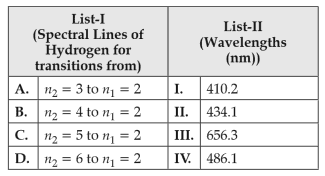
10. Given below are two statements :
Statement I : Atoms are electrically neutral as they contain equal number of positive and negative charges .
Statement II : Atoms of each element are stable and emit their characteristic spectrum .
In the light of the above statements, choose the most appropriate answer from the options given below :
Statement I : Atoms are electrically neutral as they contain equal number of positive and negative charges .
Statement II : Atoms of each element are stable and emit their characteristic spectrum .
In the light of the above statements, choose the most appropriate answer from the options given below :
(1).Statement I is correct but Statement II is incorrect .
(2). Statement I is incorrect but Statement II is correct .
(3). Both Statement I and Statement . II are correct .
(4). Both Statement I and Statement II are incorrect .
Solution
Solution
Solution
Year: 2023
Topic: Atoms
13. The radius of inner most orbit of hydrogen atom is \(\displaystyle 5.3 \times 10^{-11} \) m. What is the radius of third allowed orbit of hydrogen atom?
(1).\(\displaystyle 1.06\, \mathring{A} \)
(2). \(\displaystyle 1.59\, \mathring{A} \)
(3). \(\displaystyle 4.77\, \mathring{A} \)
(4). \(\displaystyle 0.53\, \mathring{A} \)
Solution
Solution
Year: 2016
Topic: Atoms
15. Given the value of Rydberg constant is \(10\,\text{m}^{-1}\), the wave number of the last line of the Balmer series in hydrogen spectrum will be
(1).\(0.5 \times 10^7\,\text{m}^{-1}\)
(2). \(0.25 \times 10^7\,\text{m}^{-1}\)
(3). \(2.5 \times 10^7\,\text{m}^{-1}\)
(4). \(0.025 \times 10^4\,\text{m}^{-1}\)
Solution
Year: 2015
Topic: Atoms
16. Consider \(3^{rd}\) orbit of \(\text{He}^+\) (Helium), using non-relativistic approach, the speed of electron in this orbit will be (given \(\text{K}\, =\,9 \times 10^9\) constant, \(\text{Z}\,=\,2\) and \(\text{h (Planck's constant)}\,=\,6.6 \times 10^{-34}Js\)
(1).\(2.92 \times 10^6\,m/s\)
(2). \(1.46 \times 10^6\,m/s\)
(3). \(0.73 \times 10^6\,m/s\)
(4). \(3.0 \times 10^8\,m/s\)
Solution
Year: 2025
Topic: Atoms
17. A particle of mass m is moving around the origin with a constant force F pulling it towards the origin. If Bohr model is used to describe its motion, the radius of the \(\text{n}^{\text{th}}\) orbit and the particle's speed v in the orbit depends on n as
(1).\(\text{r}\propto{n^{\frac{4}{3}}}\), \(\text{v}\propto{n^{-\frac{1}{3}}}\)
(2). \(\text{r}\propto{n^{\frac{1}{3}}}\), \(\text{v}\propto{n^{\frac{1}{3}}}\)
(3). \(\text{r}\propto{n^{\frac{1}{3}}}\), \(\text{v}\propto{n^{\frac{2}{3}}}\)
(4). \(\text{r}\propto{n^{\frac{2}{3}}}\), \(\text{v}\propto{n^{\frac{1}{3}}}\)