You are yet to try out questions in this topic. Performance Summary not avialable
Questions Available: 35
Questions Attempted: 0
Number of Attempts: 0
Correct Attempts: 0
Total Time Spent: 00:00
Avg Time Per Question: 00:00
Year: 2024
Topic: Gravitation
1. The escape velocity for earth is \(v\). A planet having 9 times mass that of earth and radius, \(16\, times\) that of earth, has the escape velocity of:
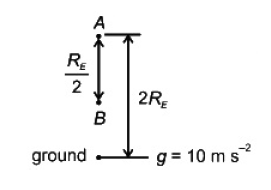
2. An object of mass \(100\,kg\) falls from point \(A\) to \(B\) as shown in figure. The change in its weight, corrected to the nearest integer is (RE is the radius of the earth)
3. The mass of a planet is \(1/10^{th}\) that of the earth and its diameter is half that of the earth. The acceleration due to gravity on that planet is:
4. The minimum energy required to launch a satellite of mass \(m\) from the surface of earth of mass \(M\) and radius \(R\) in a circular orbit at an altitude of \(2R\) from the surface of the earth is:
5. Two bodies of mass \(m\) and \(9m\) are placed at a distance \(R\). The gravitational potential on the line joining the bodies where the gravitational field equals zero, will be ( \(G= gravitational\, constant\))
6. A satellite is orbiting just above the surface of the earth with period \(T\). If \(d\) is the density of the earth and \(G\) is the universal constant of gravitation, the quantity \(3π/Gd\) represents
7. The escape velocity of a body on the earth surface is \(11.2\,km∕ s\). If the same body is projected upward with velocity \(22.4\,km∕ s\), the velocity of this body at infinite distance from the centre of the earth will be:
9. A body of mass \(60\,g\) experiences a gravitational force of \(3.0\,N\), when placed at a particular point. The magnitude of the gravitational fieldintensity at that point is
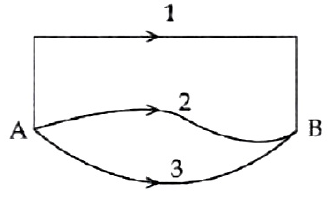
11. A gravitational field is present in a region and a mass is shifted from \(A\) to \(B\) through different paths as shown. If \(W_1\) \(W_2\) and \(W_3\) represent the work done by the gravitational force along the respective paths, then:
12. In a gravitational field, the gravitational potential is given by, \(V = − \frac{K}{X}\,\left(J ∕ kg\right)\).The gravitational field intensity at point \(\left(2, 0, 3\right)\,m\) is :
13. The ratio of Coulomb's electrostatic force to the gravitational force between an electron and a proton separated by some distance is \(2.4 × 10^39\). The ratio of the proportionality constant, \(K = \frac{1}{4πε_0}\) to the Gravitational constant \(G\) is nearly (Given that the charge of the proton and electron each = \(1.6 × 10^{−19}\, C\), the mass of the electron = \(9.11 × 10^{−31}\, kg\), the mass of the proton = \(1.67 × 10^{−27}\, kg\) ) :
14. The escape velocity from the Earth's surface is \(v\). The escape velocity from the surface of another planet having a radius, four times that of Earth and same mass density is
15. A particle of mass \(' m '\) is projected with a velocity \(v = kV_e\left(k < 1\right)\) from the surface of the earth.(\(V_e = escape\, velocity\)) The maximum height above the surface reached by the particle is
19. The time period of a geostationary satellite is \(24\,h\), at a height \(6R_E\) (\(R_E\) is radius of earth) from surface of earth. The time period of another satellite whose height is \(2.5R_E\) from surface will be,
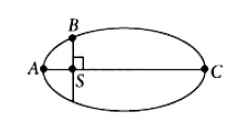
20. The kinetic energies of a planet in an elliptical orbit about the Sun, at positions \(A\), \(B\) and \(C\) are \(K_A\), \(K_B\) and \(K_C\), respectively. \(AC\) is the major axis and \(SB\) is perpendicular to \(AC\) at the position of the Sun \(S\) as shown in the figure. Then
21. If the mass of the Sun were ten times smaller and the universal gravitational constant were ten times larger in magnitude, which of the following is not correct?
(1).Raindrops will fall faster
(2). Walking on the ground would become more difficult
(3). Time period of a simple pendulum on the Earth would decrease
24. At what height from the surface of earth the gravitation potential and the value of g are \(−5.4 × 10^7J kg^{−2}\) and \(6.0ms^{−2}\) respectively? Take the radius of earth as 6400 km.
25. The ratio of escape velocity at earth (\(v_e\)) to the escape velocity at a planet (\(v_p\)) whose radius and mean density are twice as that of earth is
27. A satellite of mass m is orbiting the earth (of radius R) at a height h from its surface. The total energy of the satellite in terms of g0, the value of acceleration due to gravity at the earth’s surface, is
28. A remote-sensing satellite of earth revolves in a circular orbit at a height of \(0.25 × 10^6\, m\) above the surface of earth. If earth’s radius is \(6.38 × 10^6\,m\) and \(g = 9.8\,ms^{−2}\), then the orbital speed of the satellite is
30. Kepler’s third law states that square of period of revolution (T) of aplanet around the sun, is proportional to third power of average distance r between sun and planet i.e.\(T^2 = K r^3\) here K is constant. If the masses of sun and planet are M and m respectively then as per Newton’s law of gravitation force of attraction between them is \(F = \frac{GMm}{r^2}\), here G is gravitational constant.The relation between G and K is described as
31. Two spherical bodies of mass M and 5M and radii R and 2R are released in free space with initial separation between their centres equal to 12R.If they attract each other due to gravitational force only, then the distance covered by the smaller body before collision is
32. A black hole is an object whose gravitational field is so strong that even light cannot escape from it. To what approximate radius would earth (mass = \(5.98 × 10^{24}kg\)) have to be compressed to be a black hole?
34. The radius of Martian orbit around the Sun is about 4 times the radius of the orbit of Mercury. The Martian year is 687 Earth days. Then which of the following is the length of 1 year on Mercury?
35. A body weighs 48 N on the surface of the earth. The gravitational force experienced by the body due to the earth at a height equal to one-third the radius of the earth from its surface is :