Your Performance Summary!
Questions Available: 36
Questions Attempted: 0
Number of Attempts: 0
Correct Attempts: 0
Total Time Spent: 00:00
Avg Time Per Question: 00:00
Year: 2024
Topic: Work, Energy, and Power
1. An object moving along horizontal x-direction with kinetic energy 10J is displaced through x = \(\left(3\hat{i}\right)\)m by the force \(\vec{F} = \left(-2\hat{i} + 3\hat{j}\right)\). The kinetic energy of the object at the end of the displacement x is
(1).10 J
(2). 16 J
(3). 4 J
(4). 6 J
Solution
Solution
Solution
Solution
Solution
Solution
Year: 2022
Topic: Work, Energy, and Power
7. An electric lift with a maximum load of 2000kg (lift + passengers) ismoving up with a constant speed of 1.5ms−1. The frictional force opposing the motion is 3000N . The minimum power delivered by the motor to the lift in watts is : (g = 10ms−2)
(1).23000
(2). 20000
(3). 34500
(4). 23500
Solution
Solution
Solution
Year: 2021
Topic: Work, Energy, and Power
10. Water falls from a height of 60 m at the rate of 15 kg/s to operate aturbine. The losses due to frictional force are 10% of the input energy.How much power is generated by the turbine?(g = 10 m/s2 )
(1).10.2 kW
(2). 8.1 kW
(3). 12.3 kW
(4). 7.0 kW
Solution
Year: 2019
Topic: Work, Energy, and Power
11. Body A of mass 4m moving with speed u collides with another body B ofmass 2m, at rest. The collision is head on and elastic in nature. After the collision the fraction of energy lost by the colliding body A is
(1).5 / 9
(2). 1 / 9
(3). 8 / 9
(4). 4 / 9
Solution
Solution
Year: 2019
Topic: Work, Energy, and Power
13. A mass m is attached to a thin wire and whirled in a vertical circle. The wire is most likely to break when
(1).inclined at an angle of \(60^\circ\) from vertical
(2). the mass is at the highest point
(3). the wire is horizontal
(4). the mass is at the lowest point
Solution
Year: 2019
Topic: Work, Energy, and Power
14. A particle of mass 5m at rest suddenly breaks on its own into three fragments. Two fragments of mass m each move along mutually perpendicular direction with speed v each. The energy released during the process is
(1).\(\frac{3}{5}mv^2\)
(2). \(\frac{5}{3}mv^2\)
(3). \(\frac{3}{2}mv^2\)
(4). \(\frac{4}{3} mv^2\)
Solution
Year: 2018
Topic: Work, Energy, and Power
15. A moving block having mass m, collides with another stationary block having mass 4m. The lighter block comes to rest after collision. When the initial velocity of the lighter block is v, then the value of coefficientof restitution (e) will be
(1).0.5
(2). 0.25
(3). 0.8
(4). 0.4
Solution
Year: 2018
Topic: Work, Energy, and Power
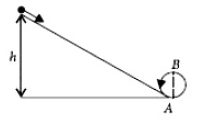
16. A body initially rest and along a frictionless track from a height h (asshown in the figure) just completes a vertical circle of diameter AB = D.The height h is equal to
(1).\(\frac{3}{2} D\)
(2). \(D\)
(3). \(\frac{7}{5} D\)
(4). \(\frac{5}{4} D\)
Solution
Year: 2017
Topic: Work, Energy, and Power
17. Consider a drop of rain water having mass 1 g falling from a height of 1km. It hits the ground with a speed of 50ms−1. Take 'g' constant with a value 10ms−2.The work done by the (i) gravitational force and the (ii) resistive force of air is
(1).A. (i) 1.25 J (ii) -8.25 J
(2). B. (i) 100 J (ii) 8.75 J
(3). C. (i) 10 J (ii) -8.75 J
(4). D. (i) -10 J (ii) -8.25 J
Solution
Year: 2016
Topic: Work, Energy, and Power
18. A particle of mass 10 g moves along a circle of radius 6.4 cm with a constant tangential acceleration. What is the magnitude of this acceleration if the kinetic energy of the particle becomes equal to 8 × 10⁻⁴J by the end of the second revolution after the beginning of the motion ?
(1).0.18 \(\frac{m}{s^2}\)
(2). 0.2\(\frac{m}{s^2}\)
(3). 0.1\(\frac{m}{s^2}\)
(4). 0.15\(\frac{m}{s^2}\)
Solution
Year: 2016
Topic: Work, Energy, and Power
19. A body of mass 1 kg begins to move under the action of time dependent force \(\vec{F}\) = \(\left(2t\hat{i} + 3t^2\hat{j}\right)\) N , where \(\hat{i}\) and \(\hat{j}\) are unit vectors along x and y axis.What power will developed by the force at the time t?
(1).(2t3 + 3t4) W
(2). (2t3 + 3t5) W
(3). (2t2 + 3t3) W
(4). (2t2 + 4t4b)
Solution
Solution
Year: 2016
Topic: Work, Energy, and Power
21. A bullet of mass 10 g moving horizontally with a velocity of 400ms−1strikes a wood block of mass 2 kg which is suspended by light inextensible string of length 5 m. As a result, the centre of gravity of the block found to rise a vertical distance of 10 cm. The speed of the bullet after it emerges out horizontally from the block will be
(1).100 ms−1
(2). 80 ms−1
(3). 120 ms−1
(4). 160 ms−1
Solution
Year: 2016
Topic: Work, Energy, and Power
22. Two identical balls A and B having velocities of 0.5ms−1 and 0.3ms−1 respectively collide elastically in one dimension. The velocities of B and A after the collision respectively will be
(1).−0.5 ms−1 and 0.3 ms−1
(2). 0.5 ms−1 and −0.3 ms−1
(3). −0.3 ms−1 and 0.5 ms−1
(4). 0.3 ms−1 and 0.5 ms−1
Solution
Solution
Year: 2015
Topic: Work, Energy, and Power
24. Two particles A and B, move with constant velocities \(\vec{v_1}\) and \(\vec{v_2}\).At the initial moment their position vectors are \(\vec{r_1}\) and \(\vec{r_2}\) respectively. Thecondition for particles A and B for their collision is
(1).\(\vec{r_1}\) × \(\vec{v_1}\) = \(\vec{r_2}\) ×\(\vec{v_2}\)
(2). \(\vec{r_1}\) −\(\vec{r_2}\) =\(\vec{v_1}\) −\(\vec{v_2}\)
(3). \(\frac{\vec{r_1} −\vec{r_2}}{|\vec{r_1} −\vec{r_2}|}\)=\(\frac{\vec{v_2} −\vec{v_1}}{|\vec{v_2} −\vec{v_1}|}\)
(4). \(\vec{r_1}\) . \(\vec{v_1}\) = \(\vec{r_2}\) .\(\vec{v_2}\)
Solution
Solution
Year: 2015
Topic: Work, Energy, and Power
26. A ball is thrown vertically downwards from a height of 20 m with an initial velocity v0.It collides with the ground, loses 50 percent of its energy in collision and rebounds to the same height. The initial velocity v0 is (Take g = 10ms−2)
(1).28 ms−1
(2). 10 ms−1
(3). 14 ms−1
(4). 20 ms−1
Solution
Year: 2015
Topic: Work, Energy, and Power
27. On a frictionless surface, a block of mass M moving at speed v collides elastically with another block of same mass M which is initially at rest. After collision the first block moves at an angle 0 to its initial direction and has a speed v/3. The second block's speed after the collision
(1).\(\frac{3}{\sqrt{2}}\)v
(2). \(\frac{\sqrt{3}}{2}\)v
(3). \(\frac{2\sqrt{2}}{3}\)v
(4). \(\frac{3}{4}\)v
Solution
Year: 2015
Topic: Work, Energy, and Power
28. A particle of mass m is driven by a machine that delivers a constantpower k watts. If the particle starts from rest the force on the particle attime t is
(1).\({\sqrt{2mkt}}^{\frac{−1}{2}}\)
(2). \(\frac{1}{2}{\sqrt{mkt}}^{\frac{-1}{2}}\)
(3). \({\sqrt{\frac{mk}{2}t}}^{\frac{−1}{2}}\)
(4). \({\sqrt{mkt}}^{\frac{−1}{2}}\)
Solution
Year: 2015
Topic: Work, Energy, and Power
29. Two particles of masses m1, m2 move with initial velocities u1 and u2.On collision, one of the particles get excited to higher level, after absorbing energy e. If final velocities of particles be v1 and v2 then we must have
(1).\(\frac{1}{2}m_1{u_1}^2\) + \(\frac{1}{2}m_2{u_2}^2\) - \(\varepsilon\) = \(\frac{1}{2}m_1{v_1}^2\) + \(\frac{1}{2}m_2{v_2}^2\)
(2). \(\frac{1}{2}{m_1}^2{u_1}^2\) + \(\frac{1}{2}m_2{u_2}^2\) -+\(\varepsilon\) = \(\frac{1}{2}{m_1}^2{v_1}^2\) + \(\frac{1}{2}{m_2}^2{v_2}^2\)
(3). \({m_1}^2{u_1}\) + \({m_2}^2{u_2}\) - \(\varepsilon\) = \({m_1}^2{v_1}\) + \({m_2}^2{v_2}\)
(4). \(\frac{1}{2}m_1{u_1}^2\) + \(\frac{1}{2}m_2{u_2}^2\) = \(\frac{1}{2}m_1{v_1}^2\) + \(\frac{1}{2}m_2{v_2}^2\) - \(\varepsilon\)
Solution
Year: 2015
Topic: Work, Energy, and Power
30. Two similar springs P and Q have spring constants KP and KQ such that KP > KQ. They are stretched first by the same amount (case a),then by the same force (case b). The work done by the springs WP and WQ are related as, in case (a) and case (b) respectively
(1).W P > W Q; W Q > W P
(2). W P < W Q; W Q < W P
(3). W P = W Q; W P > W Q
(4). W P = W Q; W P = W Q
Solution
Year: 2014
Topic: Work, Energy, and Power
31. A body of mass (4m) is lying in x-y plane at rest. It suddenly explodesinto three pieces. Two pieces, each of mass (m) move perpendicular toeach other with equal speeds (v). The total kinetic energy generated dueto explosion is
(1).mv2
(2). 32mv2
(3). 2mv2
(4). 4mv2
Solution
Year: 2024
Topic: Work, Energy, and Power
32. Two bodies A and B of same mass undergo completely inelastic one dimensional collision. The body A moves with velocity v1 while body B is at rest before collision. The velocity of the system after collision is v2. The ratio v1 : v2 is
(1).1 : 2
(2). 2 : 1
(3). 4 : 1
(4). 1 : 4
Solution
Year: 2024
Topic: Work, Energy, and Power
33. A bob is whirled in a horizontal plane by means of a string with an initial speed of ω rpm.The tension in the string is T. If speed becomes 2ω while keeping the same radius, the tension in the string becomes:
(1).T
(2). 4T
(3). T/4
(4). \(\sqrt{2}\) T
Solution
Year: 2015
Topic: Work, Energy, and Power
34. A block of mass 10 Kg, moving in x-direction with a constant speed of \(10\, \text{ms}^{-1}\), is subjected to a retarding force
F = 0.1 x J/m during its travel from x = 20 m to 30 m. Its final KE will be
F = 0.1 x J/m during its travel from x = 20 m to 30 m. Its final KE will be
(1).475 J
(2). 450 J
(3). 275 J
(4). 250 J
Solution
Year: 2025
Topic: Work, Energy, and Power
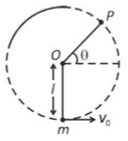
35. A bob of heavy mass m is suspended by a light string of length l. The bob is given a horizontal velocity \(v_0\) as shown in the figure. If the string gets slack at some point P making an angle \(\theta\) from the horizontal, the ratio of the speed v of the bob at point P to its initial speed \(v_0\) is:
(1).\(\displaystyle \left(\frac{sin\theta}{2+3sin\theta}\right)^{\frac{1}{2}}\)
(2). \(\displaystyle \left(sin\theta \right)^{\frac{1}{2}}\)
(3). \(\displaystyle \left(\frac{1}{2+3sin\theta}\right)^{\frac{1}{2}}\)
(4). \(\displaystyle \left(\frac{cos\theta}{2+3sin\theta}\right)^{\frac{1}{2}}\)
Solution
Year: 2025
Topic: Work, Energy, and Power
36. The kinetic energies of two similar cars A and B are 100J and 225 J respectively. On applying breaks, car A stops after 1000 m and car B stops after 1500 m. If \(\text{F}_\text{A}\) and \(\text{F}_\text{B}\) are the forces applied by the breaks on cars A and B, respectively, then the ratio \(\text{F}_\text{A}\,/ \,\text{F}_\text{B}\) is
(1).\(\displaystyle \frac{1}{2}\)
(2). \(\displaystyle \frac{3}{2}\)
(3). \(\displaystyle \frac{2}{3}\)
(4). \(\displaystyle \frac{1}{3}\)